Showing posts with label death. Show all posts

Saturday, July 23, 2011

OFF THE SHELF -- The Hunger Games


The Hunger Games 
Scholastic, 2008

The Hunger Games is the first book of the dystopian trilogy, The Hunger Games, followed by Catching Fire and Mockingjay. The series combines the political statement of 1984 with the dangerous societal games of The Running Man, using teenagers as main characters.  While the YA target audience is middle and high school, I did suggest this first book to a few 5th graders already reading middle school books.  Before long, most of the 5th and 4th grade faculty had read the trilogy.  

Level:  6th - adult

Friday, July 22, 2011

OFF THE SHELF--When a Pet Dies


When a Pet Dies 
by Fred Rogers , Jim Judkis (Photographer) 
Penguin, 1998

Mr. Rogers talks sensitively about the emotions people feel as a beloved pet dies.  He discusses the grief and healing processes, reassuring the children that this part of life.  When a community death touched much of our population, teachers of lower grades sought resources to help the children understand death.  With this book, the teachers were able to first talk about death and grief and healing; and, then, they talked about the tragic event and loss of a father, uncle, friend of the family. 

Level:  PreK-3rd

Tuesday, July 19, 2011

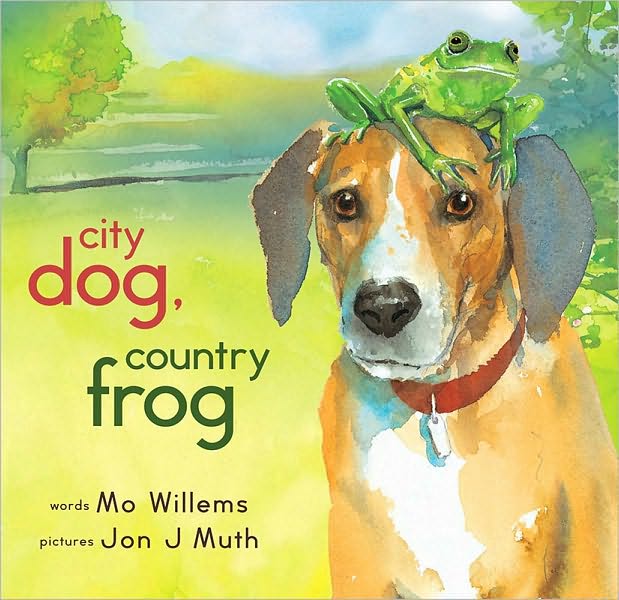
City Dog, Country Frog


City Dog, Country Frog 
Hyperion, 2010

Summary:  Told in soft water colors, the City Dog visits the country and befriends the County Frog.  As the seasons pass, they play froggie and doggie games, until one disappears forever. It's use of parallel structure with each season makes it easy for younger readers to follow. 

Lesson:  I read this book as part of a book talk promoting new books in the library and the students loved it.  Several purposes jump to mind for its use in the library or classroom.  One is the seasonal changes that occur.  A second is the comparison with the original city mouse/country mouse tale.  Another is a biology lesson about animals and seasons/weather.  And a fourth is one about death being part of the cycle of life, and moving forward after it strikes a loved one.  Finally, that death is actually left up for interpretation, and so asking students what happened to the missing animal is a good discussion on reading between the lines. 

Level:  Kinder--3rd

Sunday, July 17, 2011

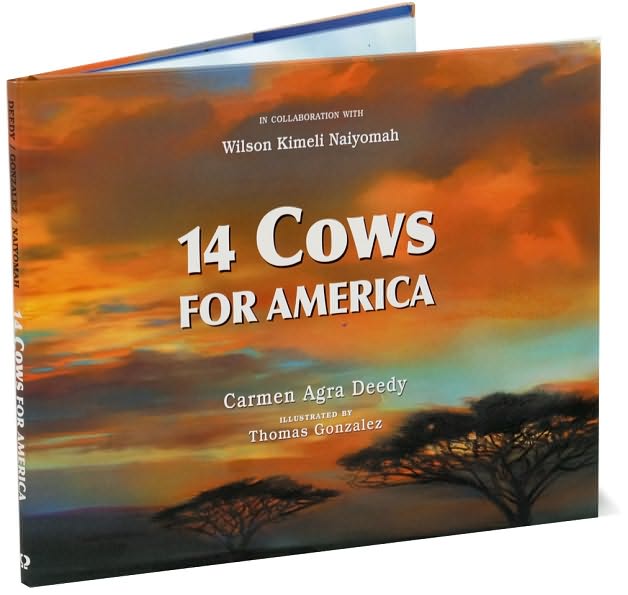
14 Cows for America


14 Cows for America
Peachtree Publishers, 2009

Summary:  In this true story, Wilson Kimeli Naiyomah returns to his home tribe the Maasai in Kenya from New York City after the attacks of 9/11.  Listening to him describe the tragedy, his tribe decides to donate a cow (their most important of possessions) to the United States of America, which later grows to 14 cows.  The pictures are vibrant, providing much cultural information.  The afterword by Naiyomah himself provides information about the fate of the cows. 

Lesson:  I read this story on anniversary of 9/11.  Many of my students had not yet been born, and had lots of questions--turning this into a history lesson.  We also talked about the importance of tolerance between peoples.  Finally, we talked about doing something for someone that is sad, like the tribe did for the sad American people.  We discussed scenarios of how even little people like kids could help a sad parent, sibling, or friend. 

Level:  1st-5th

Saturday, July 16, 2011

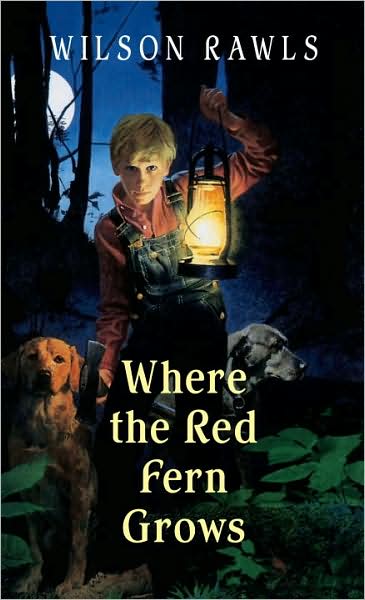
OFF THE SHELF -- Where the Red Fern Grows


Where the Red Fern Grows
by Wilson Rawls
Curtis Publishing, 1961

Throughout the year, several boys came to me looking for dog books.  They were aware of Sounder and Old Yeller, but not Where the Red Fern Grows.  I remember crying harder at this book than any I have ever cried through (but of course, I didn't tell the guys that).  I then noticed it was being checked out by word of mouth. It is the story of the bond that form between a boy and his two hunting dogs. So consider reading it, or re-reading it. 

Level:  4th - 12th