Showing posts with label Caldecott. Show all posts

Thursday, August 25, 2011

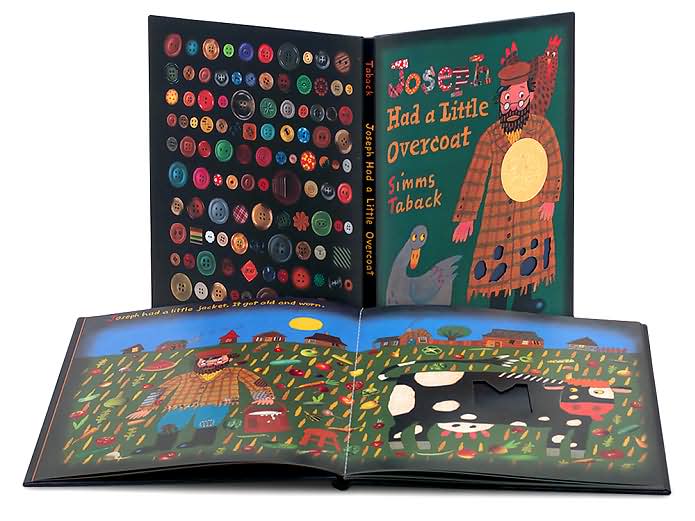
Joseph had a Little Overcoat

Joseph Had a Little Overcoat 
Penguin, 2000 Caldecott


Summary:  In this cut-out book, Joseph begins the story wearing a colorful overcoat.  As it becomes worn, with each page, he recuts the fabric to create a new, smaller garment.  From a vest to a scarf, he continues with each page until there is only enough fabric to cover a button. 

Lesson:  As part of Earth Day, we talk to the students about "Reduce, Reuse, & Recycle".  This is a great story to model how to reuse materials.  Instead of throwing away something when we are finished with it, we can find new uses.  A crafty follow-up would be to have them turn items into new products.  For example, with some string and the bottom half of a plastic bottle, they can make bird feeders.  Old cans can be decorated and turned into pencil holders.  Scrapped paper can be decorated into bookmarks.  Let your imagination sore!

Level:  K-2nd

Monday, August 15, 2011

Hey, Al

Hey, Al 
by Arthur Yorinks , Richard Egielski (Illustrator)
Farrar, Straus and Giroux, 1989 Caldecott

Summary:  Al's life is routine and plain, until he opens the door and is transported to a tropical island.  As he enjoys himself and relaxes, he becomes one with the island. 

Lesson:  A teacher was looking for a book to model word choice in replacing the overuse of  "he said".  In this book, Al squawks, croaks--anything but "says". 

Level: K-3rd

Monday, August 8, 2011

Officer Buckle and Gloria


Officer Buckle and Gloria 
Penguin, 1995, Caldecott 

Summary:  Officer Buckle's job is to give safety speeches to school staff and students.  No one really listens to him until he buddies up with a dog named Gloria.  What Officer Buckle doesn't know in the narrative text, but is visual in the pictures, is that Gloria is acting out the scenarios, capturing the audience's attention.  But when he finds out, can he handle being upstaged by his partner?

Lesson:  I use this book to talk about the powers of observation.  If you do not see the pictures, then the story doesn't make sense.   We also discuss the safety tips in the book.  Another topic is the power of teamwork. 

Level: PreK-2nd

Wednesday, August 3, 2011

A Sick Day for Amos McGee


A Sick Day for Amos McGee 
by Philip C. Stead , Erin E. Stead (Illustrator) 
Roaring Brook Press, 2010  Caldecott Award

Summary:  The zookeeper Amos McGee gives all the animals special attention.  But when he takes a sick day, they come to give him special attention.

Lesson:  I used this book in a lesson about Fiction vs. NonFiction.  It was paired with the NonFiction title A Day in the Life of a Zookeeper by Nate LeBoutillier.  The book can also be used in lessons about animals and about compassion and caring for the sick. 

Level:  PreK-2nd

Friday, July 29, 2011

Where the Wild Things Are

Where the Wild Things Are
1964, Caldecott Medal 

Summary: Mas, after running wild through the house, is sent to his room.  He creates an imaginary forest, which he cruises away to, becoming King of the Wild Things that live there. 

Lesson:  This book was part of my Halloween unit, which also included Skeleton Hiccups and the song, "Monster Mash".  First I read Skeleton Hiccups.  The children, without much prompting on my part, loved doing the hiccups sound effects for each page.  I then read Where the Wild Things Are.  During the dancing section of the story, I played "The Monster Mash" and we all danced like monsters and zombies.  We returned to end the story.  The kids were then given handouts with a skeleton on it for them to color as they wished.  (If more time had allowed, I would have allowed glue-ons, like string for hair.)

Level:  PreK-2nd

Wednesday, July 27, 2011

The Snowy Day


The Snowy Day
1963, Caldecott Medal

Summary:  Waking up to a snowy day, a young boy enjoys playing in the snow. 

Lesson:  2010 Read for the Record title. When I decided our campus would contribute in the Read for the Record event, my students were elated to be part of something that was worldwide.  Instead of reading the book to them, I decided to make it feel more global by showing the online book version.  The images were bigger and easier to see, so afterwards, I talked about the Caldecott Medal for artwork in a book.   

Level:  PreK - 2nd